
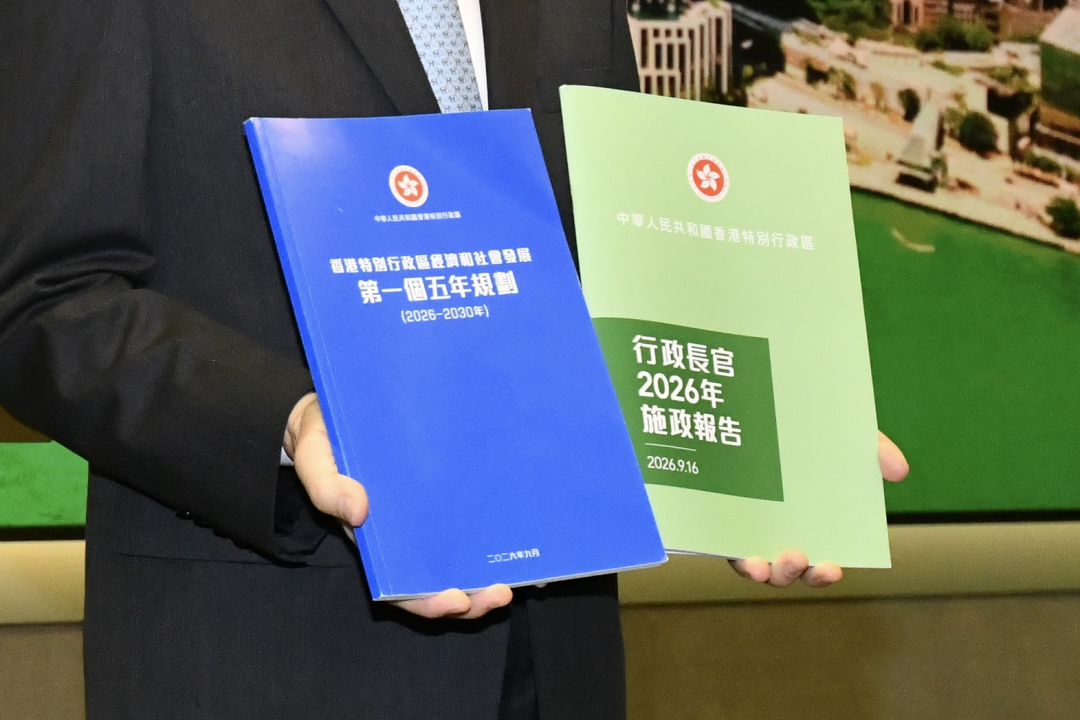

On 16 September 2026, the Hong Kong SAR Government announced its first Five-Year Plan for Economic and Social Development (2026–2030), alongside the 2026 Policy Address.
The Five-Year Plan sets out Hong Kong’s development priorities for the next five years, including strengthening its position in finance, trade, innovation and technology, talent and international education. The 2026 Policy Address sets out measures to advance these priorities. Read Hong Kong’s First Five-Year Plan and the 2026 Policy Address.
For businesses, investors and high-net-worth families, several developments are particularly relevant, from support for Mainland enterprises expanding overseas and proposed tax incentives to corporate treasury centres, cross-border investment, family offices and new investment opportunities.
Here are the key developments to know.
1. Hong Kong Is Strengthening Support for Businesses Expanding Overseas

Hong Kong is strengthening its role as a platform for Mainland enterprises expanding into international markets.
The GoGlobal Task Force, established in October 2025, has supported more than 340 Mainland enterprises in areas including listing and financing in Hong Kong, overseas standards, industry certification and compliance. Around 30% have established Hong Kong as their regional or international headquarters or corporate treasury centre, according to the 2026 Policy Address.
The Task Force will also expand its Cross-sectoral Professional Services Platform to include environmental, social and governance (ESG) services, while strengthening connections between Mainland enterprises and Hong Kong professional service providers.
For companies expanding into Southeast Asia, the Middle East, Europe and other international markets, these measures reinforce Hong Kong's positioning as a platform for accessing financing, professional services and international business networks.
Corporate Treasury Centres Are Receiving Greater Policy Support
Hong Kong is also seeking to attract more companies to establish corporate treasury centres (CTCs).
Corporate treasury centres can centralise functions such as intra-group financing, cash management, foreign exchange and liquidity management for companies operating across multiple jurisdictions.
Hong Kong announced an Action Plan to Promote Development of Corporate Treasury Centres in June 2026 and launched a public consultation on proposed enhancements to the tax concession regime in July. The Government has stated that it plans to introduce an amendment bill in the first half of 2027.
For multinational groups operating across Asia, the development of the CTC regime is therefore worth monitoring when considering where to locate regional treasury and financing functions.
2. Hong Kong Proposes 5% or Half-Rate Tax Incentives for Selected Enterprises

One of the more significant announcements in the 2026 Policy Address is a proposed preferential tax regime for selected enterprises.
The Financial Services and the Treasury Bureau plans to introduce an amendment bill to the Legislative Council by the end of 2026, providing preferential tax rates of 5% or half-rate for selected enterprises operating in key sectors including finance, advanced manufacturing, innovation and technology R&D, headquarters activities, logistics and supply chain management. See the 2026 Policy Address.
Importantly, this is a proposed measure and is not currently a general 5% tax rate available to all Hong Kong companies.
For companies considering Hong Kong for regional headquarters, logistics, supply chain or other strategic functions, the measure may become relevant once the legislation and detailed eligibility requirements are finalised.
Hong Kong Has Signed Its 60th Comprehensive Double Taxation Agreement
Hong Kong has also continued to expand its international tax treaty network.
On 4 September 2026, Hong Kong signed a Comprehensive Double Taxation Agreement (CDTA) with Slovenia, its 60th CDTA. This followed agreements with Cyprus in June and Nigeria in July. View Hong Kong's CDTA updates.
The Slovenia agreement has been signed but, as at 17 September 2026, has not yet entered into force.
CDTAs generally provide greater certainty on taxing rights between jurisdictions and mechanisms for relieving double taxation. The application of treaty benefits depends on the relevant agreement and the circumstances of the taxpayer.
3. Overseas Companies Can Re-Domicile to Hong Kong

Established overseas companies now have another option when considering Hong Kong.
Hong Kong's Company Re-domiciliation Regime came into operation on 23 May 2025. It allows eligible non-Hong Kong companies to re-domicile to Hong Kong while preserving their legal identity, subject to the applicable requirements.
By the end of June 2026, the Companies Registry had received 70 applications, of which 42 companies had successfully re-domiciled to Hong Kong, including two insurance companies and one listed company. See the Companies Registry statistics.
For established international groups, re-domiciliation may provide an alternative to setting up an entirely new Hong Kong company.
However, eligibility depends on factors including the company's existing structure and whether its original jurisdiction permits outward re-domiciliation.
4. Hong Kong Is Expanding Cross-Border RMB Business

Hong Kong is continuing to strengthen its position as a global offshore renminbi business hub.
The RMB Business Facility has been expanded to RMB500 billion, while the maximum loan tenor has been extended to three years.
The Hong Kong Monetary Authority will also introduce a seven-day offshore RMB liquidity tender mechanism to provide banks with an additional channel for meeting short-term RMB financing needs. See the 2026 Policy Address.
For businesses conducting significant transactions with Mainland China, the continued expansion of Hong Kong's offshore RMB market provides additional options to consider when structuring financing, settlement and treasury arrangements.
Digital Finance and Commodity Trading Are Also Expanding
Hong Kong is also continuing to develop digital finance and tokenisation as part of its financial market strategy.
At the same time, the Government is developing a broader commodity trading ecosystem covering areas such as gold trading, storage, clearing, financing, insurance and risk management.
The 2026 Policy Address states that Hong Kong will implement a half-rate tax concession for physical commodity trading. It will also explore additional tax concessions for qualifying activities within the gold and commodity trading ecosystem. See the 2026 Policy Address Highlights.
The distinction is important: the half-rate concession for physical commodity trading is being implemented, while further concessions covering other qualifying gold and commodity activities remain under exploration.
5. Hong Kong Is Mobilising More Capital for Innovation and Technology
Innovation and technology is another major focus of Hong Kong's economic strategy.
One of the key initiatives is the HK$10 billion Innovation and Technology Industry-Oriented Fund (ITIF).
The ITIF targets five areas:
Life and health technology, artificial intelligence and robotics, semiconductors and smart devices, digitalisation, upgrading and transformation, and future and sustainable development.
The Government will participate as a limited partner in sub-funds managed by selected professional fund managers. Its commitment will not exceed 25% of each sub-fund, and total government contributions are capped at HK$10 billion.
The overall target size of all sub-funds is at least HK$40 billion. See the official ITIF programme.
The 2026 Policy Address states that around 20 fund managers have been preliminarily shortlisted, while an additional HK$1 billion has been earmarked for the enhanced Innovation and Technology Venture Fund scheme.
Importantly, the ITIF is an investment fund rather than a general business grant. Companies do not simply apply for a fixed government subsidy. Investment decisions will be made through the relevant fund structures and fund managers.
For technology businesses, this represents part of Hong Kong's wider effort to attract private capital into strategically important innovation sectors.
6. Hong Kong Is Enhancing Its Family Office and Fund Tax Framework
Hong Kong is also continuing to develop its position as an international asset and wealth management centre.
On 12 June 2026, the Government gazetted the Inland Revenue (Amendment) (Preferential Tax Regimes for Funds, Family-owned Investment Holding Vehicles and Carried Interest) Bill 2026.
The Bill proposes several changes, including:
expanding the definition of a fund, broadening the scope of qualifying investments, removing the 5% threshold for incidental transactions, relaxing the tax exemption treatment for special purpose entities and family-owned special purpose entities, and enhancing the tax regime for carried interest. See the Inland Revenue Department announcement.
As at September 2026, these changes should still be described as proposed amendments under the Bill, rather than as fully enacted tax rules.
The Inland Revenue Department has, however, introduced a transitional administrative measure allowing taxpayers eligible for the proposed concessions to submit their 2025/26 tax returns on the basis proposed under the Bill, subject to adjustment if necessary. See the IRD guidance.
For families considering Hong Kong for a family office, tax treatment is only one part of the overall structure. The location of investments, family businesses, management functions and succession arrangements should also be considered.
7. Hong Kong Is Expanding International Education and the Northern Metropolis University Town
Education is another area with a measurable target under Hong Kong's Five-Year Plan.
Hong Kong aims to increase the number of non-local students enrolled in full-time, locally accredited post-secondary programmes from 79,800 in the 2024/25 academic year to 100,000 by 2029/30, representing a targeted cumulative increase of 25%. Read the Five-Year Plan.
The Government is also developing the “Study in Hong Kong” brand to attract more international students.
A major part of the longer-term education strategy is the Northern Metropolis University Town, comprising three university towns in San Tin, Hung Shui Kiu and Ta Kwu Ling.
Together, the three university towns will cover more than 1,000 hectares, with approximately 300 hectares of campus areas.
The Government plans to commence site allocation for the Hung Shui Kiu University Town campus area in 2026 and support institutions to establish a presence by 2027 to 2028. See the Five-Year Plan's Northern Metropolis section.
Separately, the 2026–27 Budget has earmarked HK$10 billion for loans to support campus development by University Grants Committee-funded universities and universities of applied sciences in the Northern Metropolis University Town. See the 2026–27 Budget.
The development may also create opportunities beyond education itself, including student accommodation, research collaboration, technology, professional services and supporting infrastructure.
What Does Hong Kong's Five-Year Plan Mean for International Businesses?
Hong Kong's first Five-Year Plan sets out a broader strategy to strengthen the city's roles in international finance, trade, innovation and technology, asset and wealth management, talent and education.
For companies considering Hong Kong, several developments are particularly relevant: greater support for overseas expansion, further development of corporate treasury centres, proposed preferential tax rates for selected enterprises, an expanding tax treaty network and the ability for eligible overseas companies to re-domicile to Hong Kong.
For investors and high-net-worth families, Hong Kong is also continuing to develop its family office, fund management, offshore RMB, innovation investment and financial market infrastructure.
Not every measure announced in the Five-Year Plan or Policy Address is immediately available. Some are already in operation, while others are proposed, under consultation or subject to future legislation.
Businesses should therefore assess the specific eligibility requirements and implementation status of each measure before making structural, tax or investment decisions.
How Lotusia Group Can Support Your Hong Kong and Asia Expansion
International expansion involves more than deciding where to incorporate a company.
Businesses need to consider corporate structure, taxation, accounting and compliance, banking, human resources, management functions and how entities across different jurisdictions work together.
Lotusia Group supports businesses with international corporate structuring, company establishment, accounting and tax, corporate compliance, human resources and cross-border expansion.
For companies evaluating Hong Kong, Singapore or a broader Asia-Pacific structure, our team can help assess the appropriate setup based on your business activities, expansion plans and long-term objectives.
Disclaimer: This article is based on publicly available information from official Hong Kong Government sources as at 17 September 2026 and is intended for general information only. It does not constitute legal, tax, investment or financial advice. Certain measures discussed above are proposed, under consultation or subject to legislative approval and may change. Businesses and investors should verify the latest requirements with the relevant authorities and obtain professional advice based on their specific circumstances.


