


Businesses advertising to customers in Singapore will soon face additional requirements when using major social media platforms.
Under Singapore’s new Code of Practice for Social Media Services (2026), Facebook, Instagram and TikTok will be required to introduce additional measures to reduce the risk of scam advertisements reaching users in Singapore.
One of the key changes is advertiser identity verification. Before advertisers targeting users in Singapore are allowed to publish advertisements, the platforms will be required to verify their identities against Government-issued records.
The three platforms are required to implement the relevant systems, processes and measures by 31 January 2027.
For businesses using social media to reach customers in Singapore, the change makes the identity of the advertiser an increasingly important part of the advertising process.

What Is Changing?
The new requirements come under Singapore’s Online Criminal Harms Act (OCHA), which allows the authorities to impose preventive measures on designated online services to address online criminal activity, including scams.
The Singapore Police Force issued the new Social Media Code in August 2026 as part of a wider update to Singapore’s Codes of Practice for designated online services.
The Government said the new measures are intended to address evolving scam tactics and make it more difficult for scammers to use online platforms to target people in Singapore.
The Social Media Code applies specifically to:
- TikTok
The decision to focus on these platforms reflects their role in Singapore’s scam landscape. According to the Singapore Police Force, social media platforms including Facebook, Instagram and TikTok accounted for about 30% of total scam cases in Singapore in 2025, with Facebook alone accounting for about 18%.
Advertiser Identity Verification Will Become a Key Requirement
For businesses, one of the most important changes is the requirement for platforms to verify advertisers before they can publish advertisements targeting users in Singapore.
Under the Social Media Code, platforms must conduct checks against Government-issued records to verify the identity of advertisers.
This means that advertising on these platforms will increasingly be tied to the identity of the business or person behind the campaign.
The requirement does not state that advertisers must be incorporated in Singapore.
Instead, the focus is on verifying who the advertiser is.
For businesses operating across several countries, this distinction is important. A company may be based outside Singapore and still target Singapore customers, but it should be prepared to provide information that allows its identity to be verified through the platform’s procedures.
The exact verification process may vary from one platform to another as the new requirements are implemented.
What Does This Mean for Overseas Companies?
The new rules do not require every overseas business targeting Singapore to establish a Singapore-incorporated company.
However, businesses should have a clear understanding of the legal entity behind their advertising activities.
This can become more complicated where a business operates through multiple companies, subsidiaries or brands.
For example, an international group may have a parent company in one jurisdiction, a Singapore subsidiary and a separate brand name used for marketing. In such cases, businesses should make sure that the relationship between the company, the brand and the advertising account is clear and properly documented.
As platform verification becomes more structured, inconsistencies in company names, registration details or other identifying information may make the verification process more difficult.
For companies entering the Singapore market, this is a good reason to review their corporate and advertising setup before launching new campaigns.
Facebook, Instagram and TikTok Are Specifically Covered
The new Social Media Code applies to Facebook, Instagram and TikTok, which have been identified as the designated social media services presenting the highest scam risk to users in Singapore.
The platforms must implement the required systems, processes and measures by 31 January 2027.
The timing is particularly relevant given the continued use of social media advertisements in phishing scams.
On 2 October 2026, the Singapore Police Force issued a separate advisory warning of a surge in phishing scams promoted through advertisements on Facebook, Instagram and TikTok.
Since July 2026, at least 246 cases had been reported, with total losses of at least S$1.4 million.
According to the police, victims were often redirected from social media advertisements to phishing websites and asked to provide card details, internet banking credentials or other sensitive information.
These incidents help explain why Singapore is placing greater emphasis on the advertising systems operated by social media platforms.
Platforms Will Have to Take More Responsibility for Scam Advertisements
Advertiser verification is only one part of the new framework.
The Social Media Code also requires platforms to take steps to prevent suspected scam advertisements from being published when they are accessible to users in Singapore.
This includes assessing advertisements for suspicious characteristics. The Code specifically refers to practices such as URL cloaking, where the actual destination of an advertisement may be concealed.
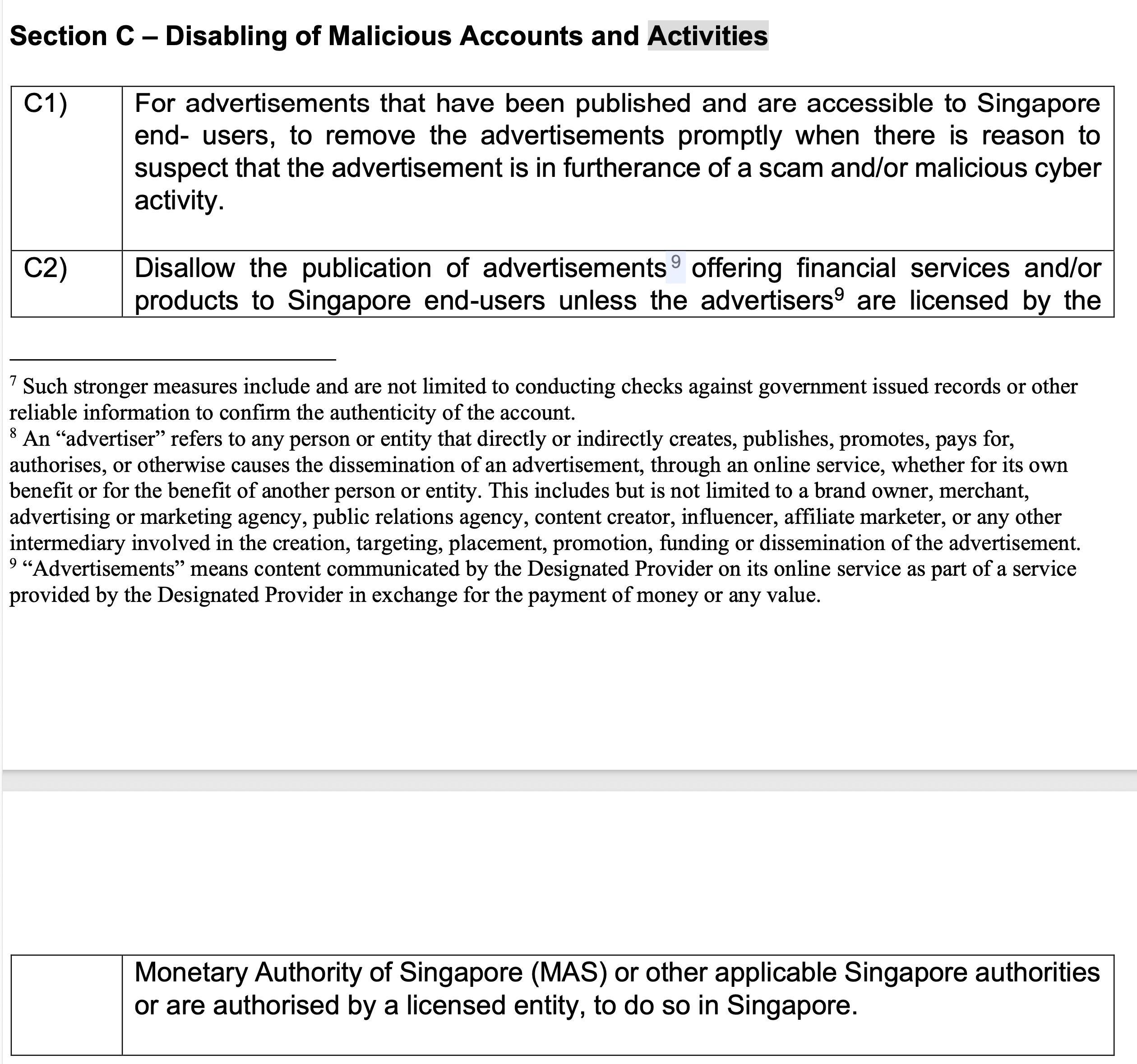
Platforms must also promptly remove suspected scam advertisements, including advertisements reported by users.
In other words, the new framework looks at both who is advertising and what is being advertised.
For businesses, this means it is worth reviewing not only the wording and creative used in an advertisement, but also the links and landing pages connected to the campaign.
Financial Services Advertising Will Face Additional Controls
Businesses promoting financial services or financial products should pay particular attention to the new requirements.
Under the Social Media Code, platforms must not allow advertisements offering financial services or products to Singapore users unless the advertiser is appropriately licensed by the Monetary Authority of Singapore (MAS), another applicable Singapore authority, or a licensed authority permitted to provide the relevant services in Singapore.
This does not mean that every company advertising in Singapore needs a financial services licence.
The relevant licensing requirements depend on the nature of the business, product or service and the applicable regulatory framework.
Businesses operating in financial services, investment or other regulated areas should therefore check the relevant requirements before launching campaigns aimed at Singapore users.
Why Is Singapore Tightening the Rules?
The new Social Media Code is part of a broader effort to address scams earlier, rather than relying solely on users to report them after they occur.
In January 2026, the Ministry of Home Affairs stated that the Government was already imposing preventive anti-scam requirements on online platforms under the Online Criminal Harms Act.
These measures included advertiser verification and user reporting.
MHA also said that the Government intended to further tighten the anti-scam requirements imposed on platforms.
The new Social Media Code announced in August 2026 is part of that wider policy direction.
For businesses, the practical effect is that online advertising is becoming more closely connected to platform-level compliance and advertiser identity.
Recent Enforcement Shows the Scale of the Issue
The stronger focus on social media advertising is also reflected in recent enforcement activity.
In September 2026, the Singapore Police Force announced that enhanced information sharing with Meta had contributed to action against nearly 3.8 million scam-linked entities, pages and accounts on Facebook and Instagram during 2026.
Between January and June, SPF referred more than 20,000 Meta accounts, pages and pieces of content to Meta after identifying signals associated with scam-related activity.
Meta subsequently took broader action against connected scam infrastructure, including more than 3.64 million shell pages that had not yet been used to conduct scams but were identified as potential infrastructure for future scam campaigns.
The figures illustrate the scale of the challenge facing online platforms and explain why Singapore is placing greater emphasis on prevention, verification and early disruption.
What Should Businesses Do Now?
Businesses do not need to wait until January 2027 to review their advertising arrangements.
A few practical steps can be taken now.
Review the Entity Behind Your Advertising Account
Identify which legal entity is responsible for each advertising account and campaign.
This is particularly important for companies that operate through multiple subsidiaries, brands or jurisdictions.
The business information associated with an advertising account should be accurate and consistent with the entity responsible for the relevant activity.
Check Your Corporate Information
Review the company information currently used across your advertising platforms.
Where verification involves Government-issued records, differences between the information submitted to a platform and the underlying corporate records could create additional verification issues.
Keeping company information up to date can make the process easier when verification is required.
Keep Supporting Documents Ready
Businesses should maintain current corporate registration and identity documents that may be required during the verification process.
The specific documents and procedures will depend on how each platform implements the new requirements.
Review Your Advertising Links and Landing Pages
The Social Media Code specifically addresses suspicious advertising practices such as URL cloaking.
Businesses should therefore review the links, redirects and landing pages used in their campaigns.
The destination of an advertisement should clearly correspond with the business, product or service being promoted.
Review Regulated Products and Services
If your business promotes financial products, investment opportunities or other regulated services, check whether the relevant activity requires licensing or authorisation in Singapore.
Advertising compliance should be considered alongside the regulatory status of the underlying business activity.
Review Your Cross-Border Advertising Structure
For international companies, it may also be useful to review the relationship between the parent company, local entities, brands and advertising accounts.
A clear structure can make it easier to identify which entity is responsible for a particular campaign and to provide supporting information if verification is required.
What Does This Mean for Companies Expanding into Singapore?
For international businesses, the new requirements are part of a wider shift in Singapore's digital business environment.
Advertising is no longer simply a marketing function. The identity of the advertiser and the nature of the business behind the campaign are becoming increasingly relevant to platform compliance.
This does not mean that a Singapore company is required simply because a business wants to advertise to Singapore users.
Instead, companies should make sure they understand which legal entity is carrying out the relevant business activity and that the entity's information can be properly verified when required.
For companies establishing a presence in Singapore, this makes it useful to consider corporate structure, business operations, regulatory requirements and digital marketing as part of the same market-entry process.
When Will the New Rules Take Effect?
The new Social Media Code of Practice was issued by the Singapore Police Force in August 2026.
Facebook, Instagram and TikTok are required to implement the relevant systems, processes and measures by:
31 January 2027
Businesses targeting Singapore users should therefore consider reviewing their advertising accounts and corporate information before the implementation deadline.
The Bottom Line
The new requirements do not prevent businesses from advertising on Facebook, Instagram or TikTok in Singapore.
What is changing is the level of accountability around who is placing the advertisement and what is being promoted.
For businesses targeting Singapore audiences, three areas are particularly worth reviewing:
Corporate identity — Make sure the legal entity behind your advertising activity is clear and that its information is accurate.
Advertising setup — Review your advertisements, URLs, landing pages and campaign structure before the new requirements take effect.
Industry-specific requirements — If your business operates in a regulated sector, make sure the products or services being promoted meet the relevant licensing and regulatory requirements.
For international companies entering the Singapore market, these checks can form part of a broader corporate and compliance review.
With Facebook, Instagram and TikTok required to implement the new measures by 31 January 2027, businesses targeting Singapore users have time to review their current arrangements and prepare for the changes.
The direction is clear: Singapore is placing greater responsibility on online platforms to prevent scam advertisements, while businesses using those platforms can expect a more structured and verifiable advertising environment.
Disclaimer: This article is provided for general informational purposes only and does not constitute legal, regulatory, tax, financial or professional advice. Requirements may vary depending on the nature of the business, advertising activity, product or service involved. Businesses should refer to the latest information published by the relevant Singapore authorities and seek professional advice where appropriate. Information in this article is based on official sources available as of October 2026.


