


Hong Kong allows foreign entrepreneurs to obtain residency through active business participation under the Entry for Investment as Entrepreneurs route, which is administered under the General Employment Policy (GEP). This visa pathway enables eligible applicants to reside in Hong Kong while establishing, investing in, or operating a business that is assessed to make a meaningful contribution to the local economy.
Unlike passive investment schemes, approval under this route is not based on capital alone. Applications are assessed holistically, with emphasis on business viability, sustainability, and economic contribution, rather than fixed financial thresholds.
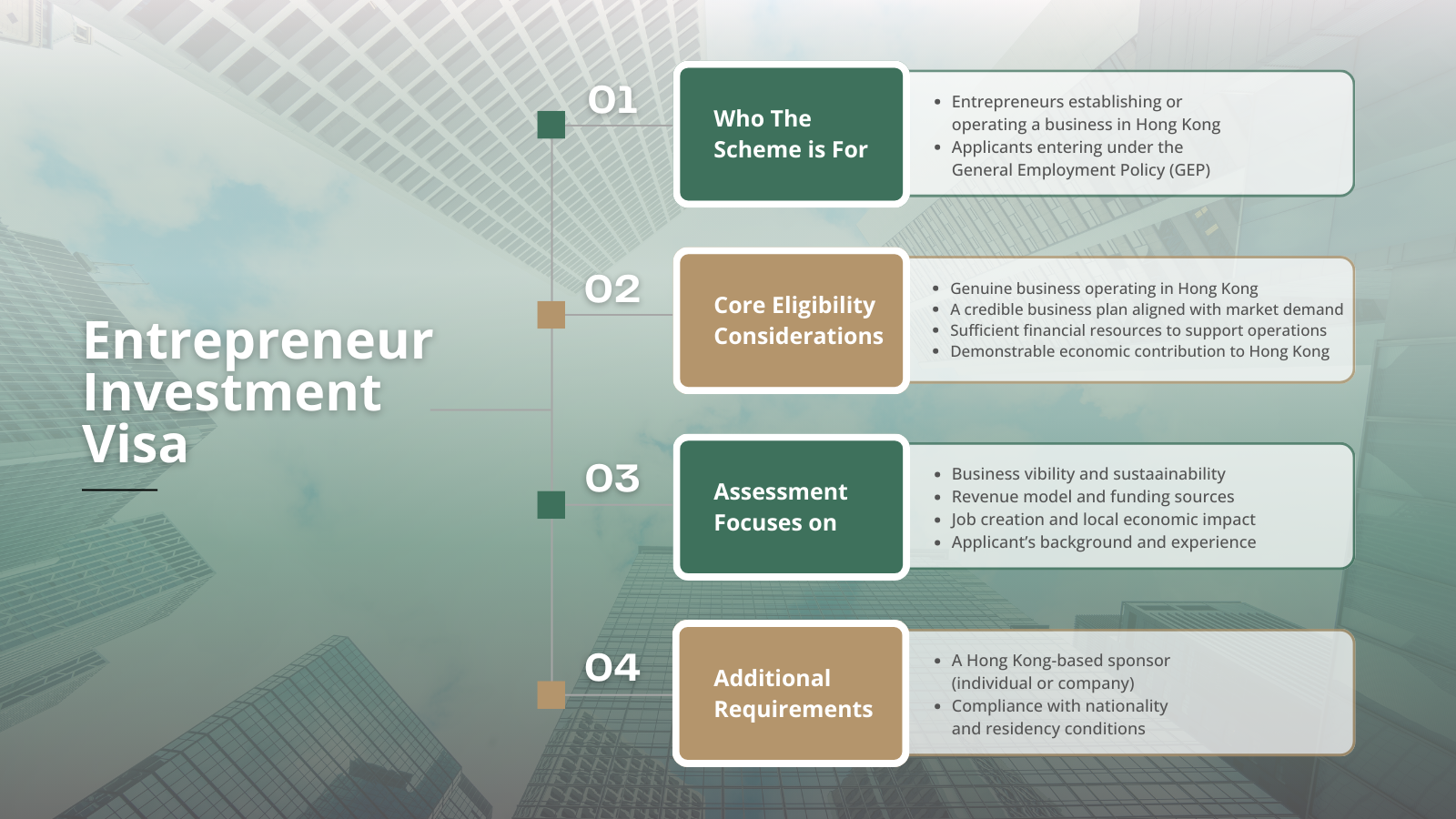
What the Entrepreneur Investment Visa is
The Entrepreneur Investment Visa is a form of employment visa issued under the General Employment Policy. It applies where the applicant is both an investor or shareholder and an active operator of a Hong Kong-registered business. The Immigration Department assesses each application on a case-by-case basis to determine whether the proposed business is likely to benefit Hong Kong’s economy.
This route is commonly used by founders expanding into Asia, business owners relocating regional operations, and entrepreneurs establishing Hong Kong as a coordination base for international or Greater Bay Area activities.
Why Entrepreneurs Use This Route
One of the defining characteristics of Hong Kong’s Entrepreneur Investment Visa is the absence of a statutory minimum investment amount. There is also no points-based assessment system. Instead, the Immigration Department focuses on whether the business can operate sustainably and generate ongoing economic value.
Successful applicants may sponsor their spouse and dependent children to join them in Hong Kong. Dependants are eligible to study in Hong Kong and access public healthcare services.
Over time, the visa also provides a pathway toward Hong Kong permanent residency for those who meet statutory residence requirements.
How Applications Are Assessed in Practice
The core assessment criterion for the Entrepreneur Investment Visa is economic contribution. Immigration authorities evaluate whether the proposed business is commercially viable and capable of contributing to Hong Kong through revenue generation, employment creation, or the introduction of skills, expertise, or technology.
Start-up and early-stage businesses are typically assessed more cautiously, as the Immigration Department examines whether assumptions are realistic and whether the business can be sustained beyond the initial establishment phase.
The Role of the Business Plan
A detailed business plan forms a central part of the application. Applicants are generally expected to submit a business plan covering a forward-looking period, commonly two years, explaining how the business will operate, generate revenue, and develop in Hong Kong.
Financial projections are reviewed to assess commercial logic and planning discipline rather than as guarantees of performance. The Immigration Department looks for consistency between the business model, funding level, and operational scale.
Investment Commitment and Financial Capacity
While Hong Kong law does not prescribe a minimum investment amount, applicants must demonstrate that the level of capital committed is reasonable and sufficient for the nature and scale of the business.
Applicants are also required to show that they have adequate financial resources to establish and operate the business and to support themselves and any dependents during their stay in Hong Kong. Supporting documents commonly include bank statements and corporate financial records.
Local Employment and Industry Contribution
Another factor considered by the Immigration Department is whether the business contributes to Hong Kong beyond the founder’s own role. Businesses that create local employment or introduce specialized industry expertise, professional skills, or technology may strengthen their applications.
Where relevant, alignment with innovation-driven or knowledge-based sectors may also be viewed positively.
Nationality and Sponsor Considerations
The Entrepreneur Investment Visa is open to most foreign nationals who meet the eligibility criteria. However, nationals of Afghanistan, Cuba, and North Korea are not eligible under current Immigration Department policy.
Mainland China residents are subject to additional conditions in practice. Applications are generally considered where the applicant holds overseas permanent residency or has resided overseas for at least one continuous year immediately prior to application and submits the application from outside Hong Kong.
Applicants must also nominate a local sponsor in Hong Kong, which may be a Hong Kong-registered company or an individual Hong Kong resident.
.png)
Visa Duration, Renewal, and Permanent Residency
Under the General Employment Policy,Entrepreneur Investment Visa holders are typically granted an initial stay of 36 months.
Visa renewal is assessed on continued business operation and economic contribution. Renewals are not automatic and are considered on a case-by-case basis.
Under Hong Kong law, individuals who have ordinarily resided in Hong Kong for at least seven continuous years may apply for Hong Kong permanent resident status. Entrepreneur Investment Visa holders are eligible to apply once this statutory requirement is met.
---
Rather than functioning as a passive residency route, the Entrepreneur Investment Visa is structured around sustained business activity and long-term participation in Hong Kong’s economy. Approval, renewal, and eventual permanent residency are all linked to whether a business continues to operate in a commercially viable and compliant manner over time.
For entrepreneurs considering Hong Kong as abase for regional or international expansion, the practical question is not simply whether a visa can be obtained, but how immigration requirements, business structuring, and ongoing operations align in practice. These elements tend to shape outcomes well beyond the initial application stage, influencing renewal decisions and long-term residency planning as the business evolves.


